Hacash Diamond, next historic NFT after CryptoPunks and Loot?
On May 13, 2021, the first NFT avatars「CryptoPunks」sold nine different characters for more than $17 million at the world’s top auction house Christie’s. Today, the price of a single CryptoPunk continues to hit new highs.
This trend of NFT avatars led by 「CryptoPunks」 started from crypto enthusiasts and is now becoming more and more popular around the world. International credit card leader Visa announced that it spent approximately US$150,000 on a “CryptoPunk”; NBA superstar Curry recently spent US$180,000 to buy an NFT Bored APE and replaced his Twitter profile with it.

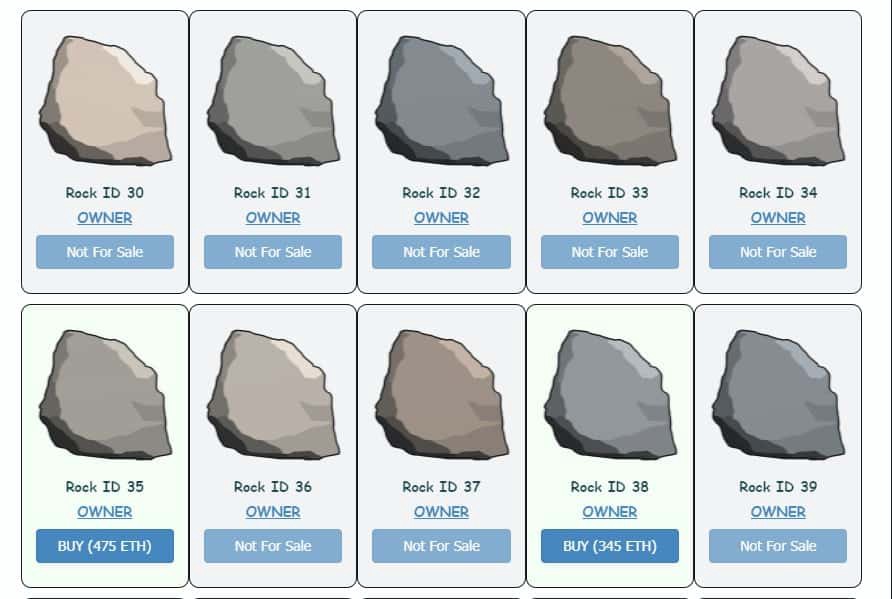
To everyone’s astonishment, some unknown and nearly extinct NFT projects revived because of this new trend. For example, an ordinary stone from the “EtherRock” series can even hit the price of 600,000 US dollars.
Why are NFTs so expensive?
An NFT may be an avatar, a painting, or a game item. The prices of these NFTs are incomprehensible and unimaginable for the vast majority of people. Even though the craze for NFT is considered a hype, a new bubble, and a scam, this trend also leads us to question: Why can’t 99% of NFTs be sold at sky-high prices like CrytpoPunk or EtherRock?
The answer lies in the value of being “the first.” In the encrypted digital world where everything can be imitated and copied, everyone recognizes the value of originality associated with these NFTs, because originality means scarcity.
「CryptoPunks」was launched in 2017 by Larva Labs, a software company in New York. They made the 10,000 “CryptoPunks” characters unique and linked to the Ethereum smart contract so that these roles could no longer be altered. And this design gave birth to the first “artwork” with an “independent record” and a “sale ownership mechanism” in human history.
For example, if there are two bowls of the same workmanship, but one was produced just yesterday and the other 1,000 years ago, their values are definitely not the same. If the old bowl is identified as the earliest human bowl by archaeologists, then this bowl must become invaluable. This set of value evaluation logic remains the same in NFT.
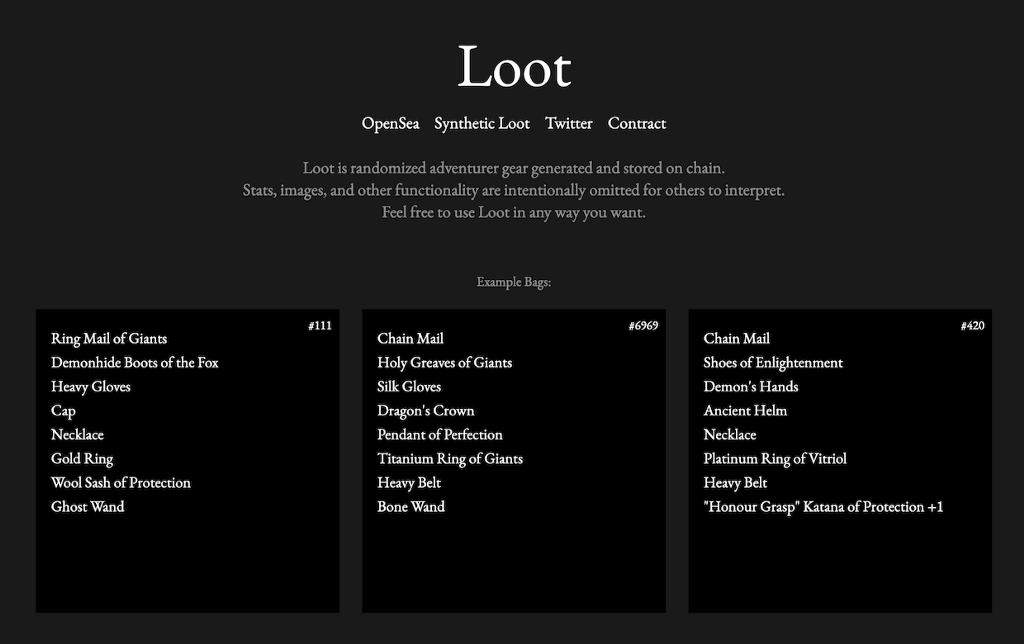
The text NFT project「Loot」has gone virus recently on the internet. Most people think that it is the first text NFT and the first community-led NFT project whose value is given by the bottom-up creation of the text by the community, not the originator or leading teams. However, it can only be justified as “the first text NFT on the Ethereum chain”, not the true originator of text and community-driven NFT.
「Loot」does seem to be more decentralized than avatar NFTs. It provides 8 lines of text, and the following story is handed over to the community to create. However, only 8,000「Loot」 can be mined, and the founder has reserved more than 222 for himself as a reward. Moreover, due to the advantages of information and capital, most of the output is directly reserved by leading holders. Compared with the fair issuance pursued in the early days of cryptocurrency, Loot’s decentralization is not so pure.
The major promoters of NFTs have shifted from pursuing originality to the spirit of decentralization of the crypto world. This transfer makes people wonder: What will the next NFT that is more decentralized and has more originality look like? In other words, what is the ultimate form of NFT? Before answering this question, let us go back to 1993.
The primitive principle of NFT
In 1993, Hal Fenny, most likely Bitcoin creator Satoshi Nakamoto, proposed the first prototype of NFT “Crypto Trading Cards.” It is a card represented by a hash string generated by an algorithm.
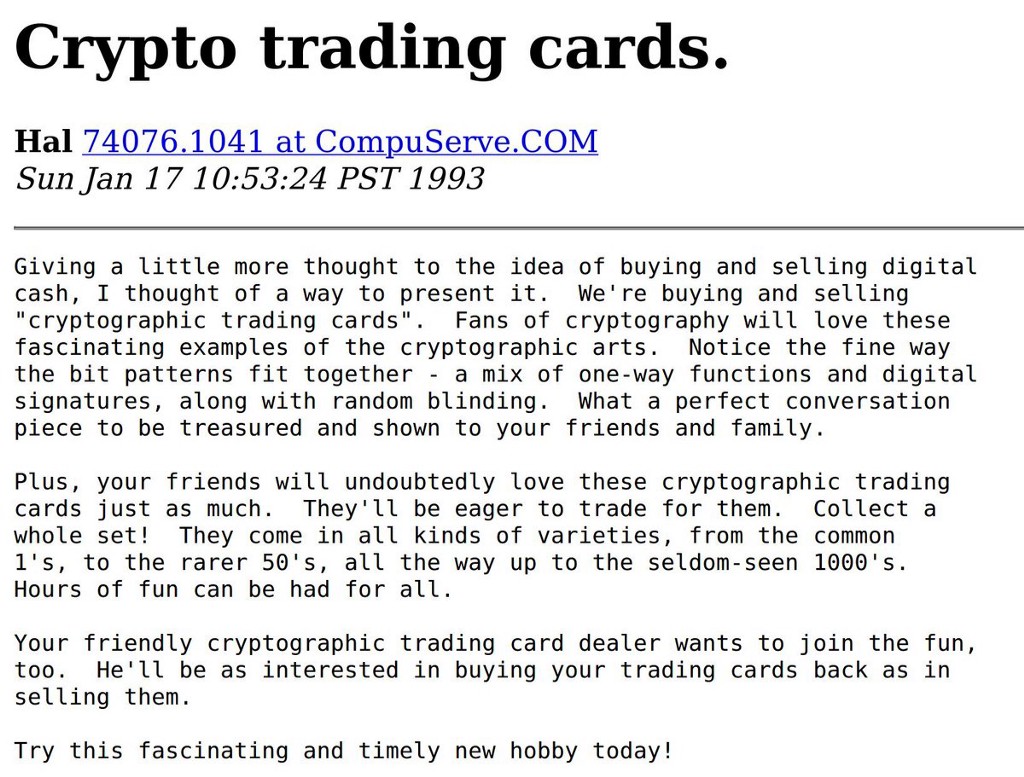
Although this card was not really implemented at the time, we can infer that any two of the randomly generated hash string representing the Crypto Trading Card cannot be equal. Because randomly generated string being equal implies that there would be an infinite number of cards (strings) that could be exactly the same.
As a result, these cards will not have any collection value unless the hash result conforms to a certain established rule, similar to a fixed PoW (Proof of Work) difficulty.
If the hash result of the Crypto Trading Card has no pre-set rules and the potential number is unlimited, then those that have collection value must be some kind of rare hash result. For example:
“000000000000007f8c5aba11cf3b5e67a2”
“d01e14a7f8c5aba11cf3b025285e67a26687”
The former will have more collection value than the latter. The former “good-looking” hash is calculated by PoW. Therefore, the greater the computing power spent, the more “good-looking” the hash result is. Then Fenny’s Crypto Trading Card must be PoW, otherwise there will be no collection and trading value for it.
The primitive principle of PoW — NFT
Let go back to 1998, when Nick Szabo, the father of smart contracts, invented Bit Gold. To put it simply, Bit Gold is an “expensive crypto gold generated by consuming electricity.”
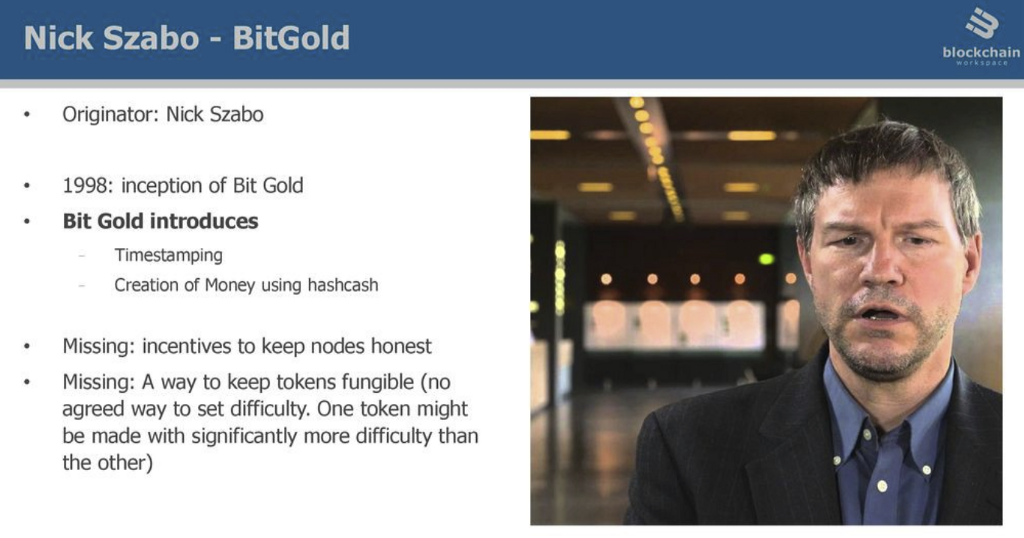
Its first key attribute is proof of work — — the proof of its computing power, therefore, its value. Bit Gold believes that a valid hash value must follow certain established rules, such as the number of leading zeros in the hash result.
Due to the unpredictability of hash values, the only way to find a valid hash is to calculate it repeatedly. Such a valid hash value can prove that its creator has indeed consumed computing power to get it. Anyone who finds a valid hash value will own the hash value.
But Bit Gold determined the “fixed difficulty” for each effective hash value, and it leads to inflation: With the participation of large computing power and the continuous improvement of computers, it will become easier and easier to generate effective hash values. As a result, the scarcity of hash will decrease, so that a large amount of hash value will dilute the overall value.
In addition to unavoidable inflation, because they are represented by a string of hash results, the cost of each Bit Gold is different. Therefore, the value between each Bit Gold is not the same and these Bit Golds cannot be exchanged. However, for currencies used in large-scale daily transaction, being exchangable is an absolutely necessary cornerstone. Szabo failed to fundamentally solve the problems of inflation and exchange, which directly led to Bit Gold’s failure even though it was only one step away from Bitcoin.
The first ever PoW-NFT: Hacash Diamond
More than 20 years later, an idea combining Finney’s crypto trading card and Szabo’s Bit Gold was proposed in a 2018 white paper called “Hacash: A Large-scale Payment Real-time Settlement Cryptocurrency System”. And on May 16, 2019, the first NFT with text: “NHMYYM” was generated on the block height of 35135 on the Hacash chain. It is composed of 6 random letters, and is called a “diamond” in the white paper. Later, as the community members called it, its name gradually evolved into the current “Hacash Diamond” (abbreviated as HACD).
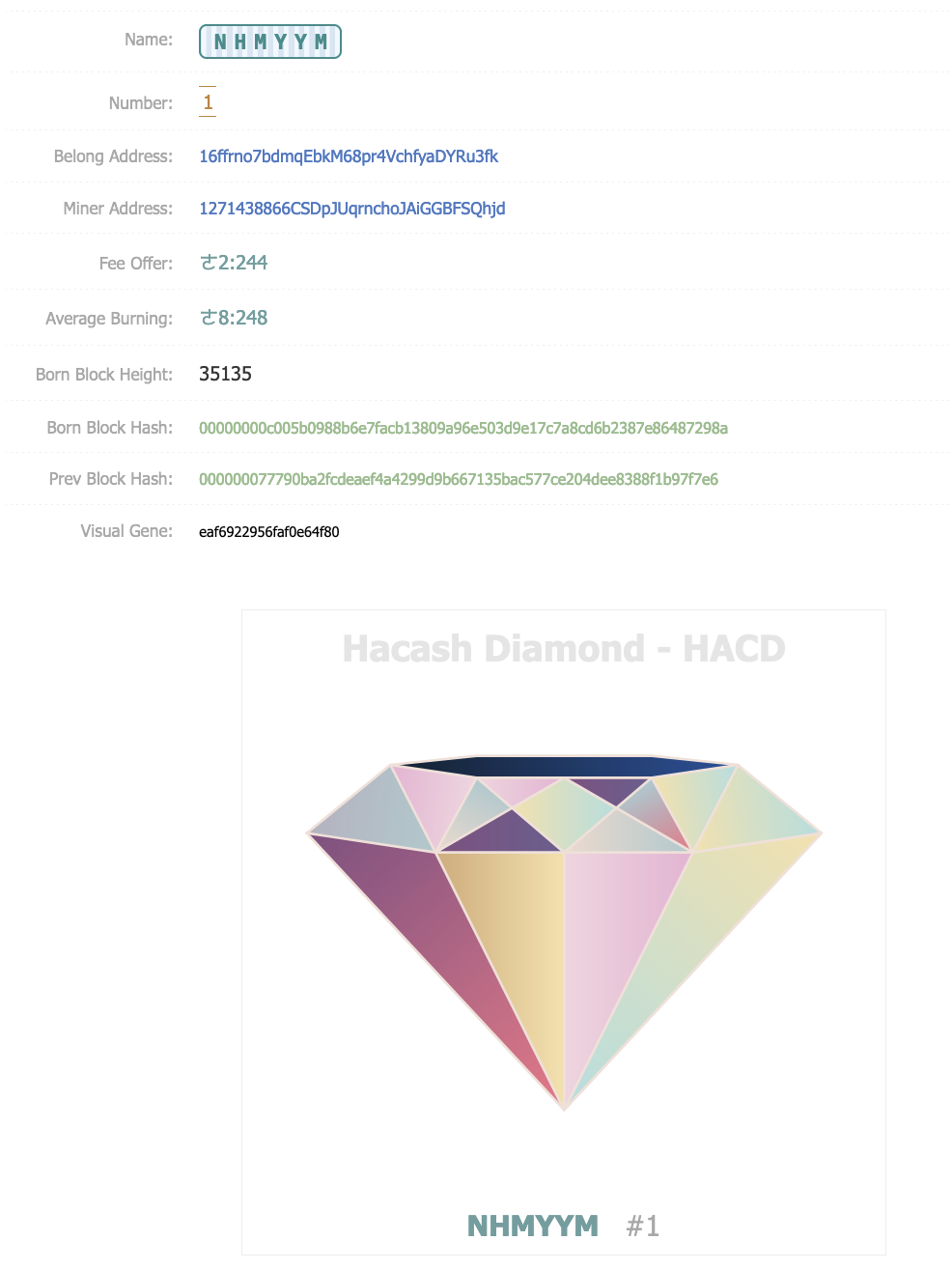
HACD creatively solves the inflation problem of Bit Gold through mechanisms such as increasing mining difficulty and bidding auctions, so that the number of diamonds produced per unit time is fixed, thus ensuring the scarcity of this “expensive crypto gold”. HACD, like Bitcoin that appeared in 2008, made the vision of Cypherpunk a reality for the first time.
With the development of HACD, on August 11, 2021, the community put forward a HIP-5 visualization proposal. It added visual diamond to each HACD. Each diamond is unique and has 9 different shapes, 16–17 facets and 16 colors. Except for the diamond shape in the middle of the figure below, the probability of other shapes of HACD to be mined is only 3%. The probability for a pure-color non-cone-shaped diamond to be mined is even slim.
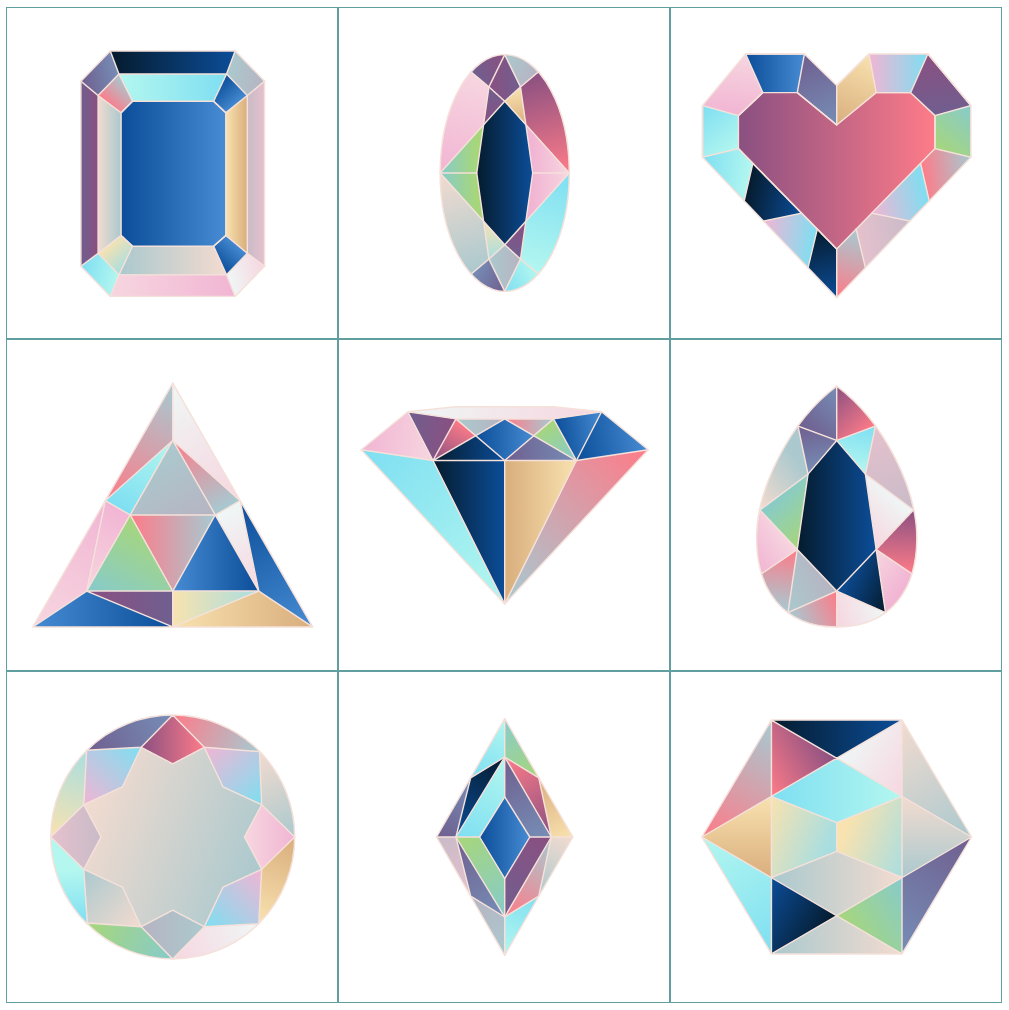
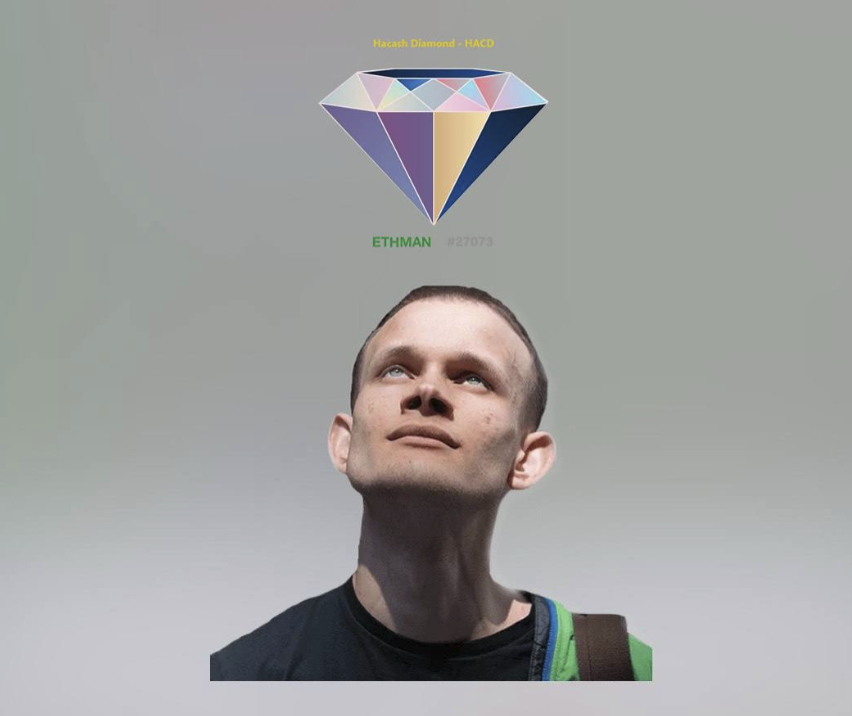
It is worth mentioning that the diamond color is jointly determined by the 6 letters and 11 hash digits of HACD. This should be the first time in NFT history that text has been used to start a bottom-up, on-chain creation of NFT. And earlier non-chain creations also came from the HACD community. For example, community members intend to give the #27073 diamond with text “ETHMAN” to Vitalik, the founder of Ethereum.
This bottom-up, decentralized spirit has been reflected through all aspects of HACD. Before the creation of the first HACD, the founder disappeared inexplicably like Satoshi Nakamoto, leaving only the white paper for the developers in the community. There is no capital manipulation and big name endorsement. It is completely operated and the community voluntarily.
Every HACD is mined like Bitcoin at the expense of computing power and bidding costs. No pre-mining, no developer rewards, and no one can exploit others in HACD at no cost. However, the drawback of such a completely decentralized, voluntary, community-driven operation is that it develops so slowly that is barely known to people ouside the circle.
In addition to being the originator of the textual NFT, HACD is also the first PoW-based NFT closest to the Finney encrypted trading card. This means that HACD can only be obtained through mining like Bitcoin, and there is no pre-mining reservation for HACD. All people use CPUs can compete and mine HACD.
Besides the competition in computing power, when a large number of HACDs are mined at the same time in a block, a coin HAC on the Hacash chain is required for bidding. The HACD with the highest bid will be packaged, and the remaining unpackaged HACD will be discarded, waiting to be mined next time.
The number of the entire HACD is limited, with a total of 16,777,216 pieces. It will theoretically take at least 800 years to be mined if not considering the increasing mining difficulty. However, as the difficulty of mining continues to increase, it will never be possible to mine up all the HACD. It is estimated that in 2025, only about 100,000 HACDs will be in circulation on the market.
Additionally, in the face of extreme situations such as the NFT market crash, when the demand for HACD in the market declines, the output of HACD will immediately drop or stop, ensuring its scarcity based on market demand.
Satoshi Nakamoto later wrote on the BitcoinTalk forum:
History is always strikingly similar. An early miner of HACD mentioned “HACD is the ‘Crypto Trading Cards’ and an implementation of Szabo’s Bitgold.”
Ultimate form of NFT
After reviewing the development history of NFT and understanding the characteristics of HACD, we seem to be able to draw a summary of the potential ultimate form of NFT:
- Originality
- Limited supply
- Community-driven
- Certain aesthetic value
- Value depends on computing power consumed
- Room for bottom-up, decentralized re-creation
- Fair issuance that constatly allows new players to participate
「Hacash Diamond」is the first text NFT. Each HACD has a unique diamond visual pattern. The number is limited. It is also the first NFT based on the PoW. It has the same decentralization as Bitcoin. It is the closest invention to Finney’s vision of NFT in 1993 and Szabo’s BitGold. Perhaps this is the ultimate form of NFT.
Today, nearly all the hot hype in the NFT field has been basically exhausted, leaving only PoW-NFT unexplored. At present, the market value of cryptocurrencies represented by PoW is still the absolute mainstream. Then, in the field of NFT, which focuses on store of value, will PoW based NFT also become the absolute mainstream? HACD already successfully bet on the Text-NFT three years in advance. Will HACD again successfully bet the next possible hot spot again: PoW-NFT?
The rise of a concept will bring about a bubble, and when the bubble breaks and the tide recedes, which NFTs are swimming naked, and which NFTs are supported by originality the decentralized community, and PoW to flourish like fungible Bitcoin, time will give the best answer.
1.资讯内容不构成投资建议,投资者应独立决策并自行承担风险
2.本文版权归属原作所有,仅代表作者本人观点,不代表本站的观点或立场
您可能感兴趣
-
 火币HTX《VIP守护者计划》|Yarra:守护每一次交易体验
《VIP守护者计划》是火币HTX推出的系列访谈栏目,聚焦大客户服务实践,每周二邀请平台一线服务团队分享真实服务经历、市场观察及客户需求洞察,传递长期主义的服务理念,展现火币HTX专业、稳健的客户服务能
-
 三星电话会:存储供不应求“明年比今年更紧张”,60-70%产能已分给长期协议,HBM4收入将占六成
作者:董静在生成式AI与Agentic AI(代理型AI)需求的强力驱动下,三星电子2026年第二季度交出了一份极具爆发力的答卷。 财报数据显示,三星电子当季实现营收171.5万亿韩元,同比暴增130
-
 美股芯片半导体跌跌不休,到底要回调到什么时候?
近来美股的存储芯片板块抛售,已经不能用单纯的"回调"两个字来形容了。昨晚,SK海力士、美光、闪迪这些昔日的芯片明星股继续集体下挫。费城半导体指数(SOX)从一个月前14,600多点的高位,一路跌到目前
-
 不发币、只收过路费:Visa 的稳定币算盘比发行方更狠
作者:Chloe,ChainCatcherVisa 公布 2026 年第三季度财报,净营收 116 亿美元、同比增长 14%,季度内支付额首度突破 4 万亿美元,是公司历史上的第一次。但真正被市场放大
-
 早报|富达 Q3 信号报告:BTC、ETH、SOL 的净未实现盈亏均处历史低位,多项指标接近投降区间;韩国金融委拟提交统一数字资产法案,在野党同步推动废除加密税
整理:ChainCatcher过去 24 小时发生了哪些重要的事? 泰国 SEC 指控 Bitkub 高管隐瞒 5000 万美元黑客损失,已提起刑事投诉 ChainCatcher 消息,泰国证券交易委
-
 加密行业每日观察:美国仲裁协会(AAA)设立 Web3 专项小组,链上纠纷进入“正规军”调解时代
直击痛点:填补 Web3 商业纠纷的司法空白 过去,加密行业的纠纷往往因为智能合约的不可篡改性(Code is Law)和去中心化底层架构,难以在传统法庭获得有效且具备执行力的裁决。 为了彻底解决这一
-
 Bitget UEX 日报|特朗普称美军将痛击伊朗;美联储按兵不动沃什重申2%目标;微软业绩超预期Meta资本开支大增 (2026年07月30日)
一、热点要闻 美联储动态 美联储按兵不动,沃什重申2%通胀目标并淡化前瞻指引美联储维持利率不变。主席沃什在新闻发布会开场明确重申,委员会坚定致力于实现2%的同比通胀目标,不存在“软目标”或任何其他隐含
-
 沃什:2% 通胀目标不动摇,保持独立性,关注AI变革(附全文)
美联储主席沃什将市场利率上行视为金融条件已在收紧的信号,同时重申2%通胀目标“没有任何弹性空间”,并宣布实质性退出前瞻指引,呼吁华尔街脱离对央行表态的依赖,“去捕捉真实的经济信号”。 美联储以9比3的
- 成交量排行
- 币种热搜榜
 泰达币
泰达币 比特币
比特币 以太坊
以太坊 USD Coin
 Solana
 瑞波币
瑞波币 Ronin Network
 币安币
币安币 World Liberty Financial USDv
 莱特币
莱特币 艾达币
艾达币 狗狗币
狗狗币 大零币
大零币 Wormhole
 比特现金
比特现金 SHIB
SHIB UNI
UNI OKB
OKB AR
AR ICP
ICP DOT
DOT LUNC
LUNC YGG
YGG DYDX
DYDX LPT
LPT ETC
ETC